A world made to whose measure?

In short
This text argues that the world was built mainly for neurotypical people. Schools, jobs and services do not always adapt to autistic people and other neurodivergent people. Inclusion laws help, but they make people prove again and again that they need support. The text proposes a world designed from the start for different ways of functioning.
The world we live in is not neutral. Over centuries, it has been designed by neurotypical people and for neurotypical people. Schools, universities, workplaces, hospitals, public services, transport and even the unwritten rules of conversation assume a "normal" way of perceiving, feeling, communicating and learning.
Those who process the world differently discover this early. They discover it in the noisy classroom lit by fluorescent lights, in the job interview that assesses eye contact instead of competence, or in the open-plan office where one is supposed to be productive surrounded by noise and interruptions. None of this was done with bad intentions. It was done, quite simply, without thinking about those who were not in the room when the decisions were made.
A majority is not the same as everyone
It is understandable that a world built by the majority reflects the majority. Neurodivergent people do, in fact, belong to minority groups. It is estimated that around 1% of the world's population is autistic, around 8% has ADHD and around 12% has Specific Learning Difficulties.
These figures vary by country, age and the criteria used, and many people have more than one of these conditions. Even so, all told, we are talking about one in every five or six people. This is not a rare exception. It is a structural part of humanity, which has always existed, even when it had no name.
The question, therefore, is not whether the majority has the right to be considered. It does. The question is why a world inhabited by an enormous (neuro)diversity of ways of processing the World, Others and oneself continues to be built as if only one existed.
The monolith, the bone and the closed door
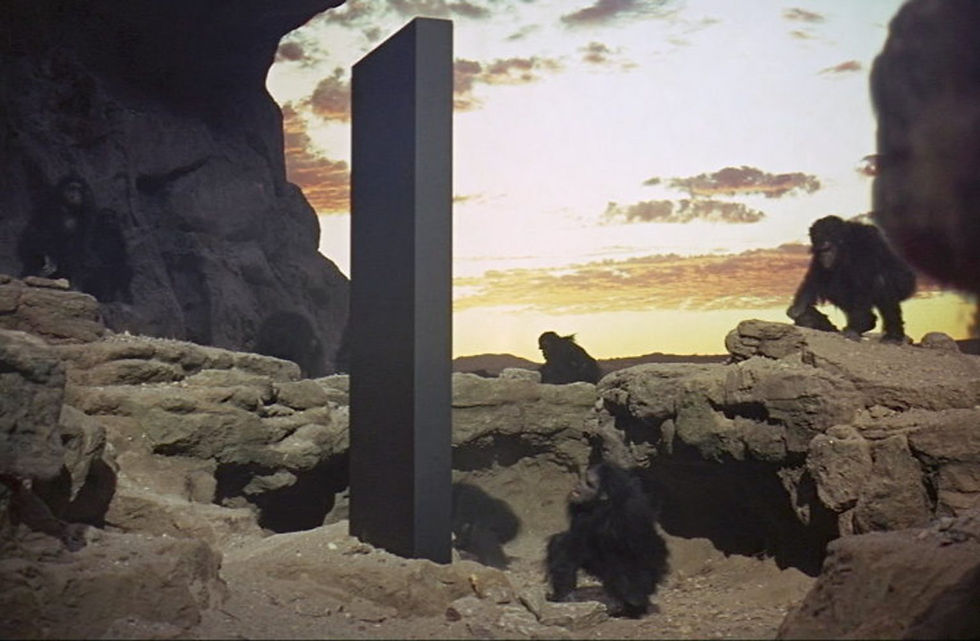
In 2001: A Space Odyssey (1968), Stanley Kubrick opens the film with a group of hominids who, one morning, find a black monolith in the middle of their territory. It is a perfectly smooth, geometric object, unlike anything in their world. The first reaction is fear: they scream, back away, become agitated. Only later do they approach and touch it. It is from this encounter with the radically different that, in the film, the species' next leap is born.
The scene reminds us that the unknown is rarely met with curiosity. Whatever does not follow the group's pattern first causes unease, and only later, if there is time and openness, understanding. Many autistic and neurodivergent people know this monolith's place well: being there, whole and coherent, and being looked at as something strange that disturbs the landscape.
Right afterwards, one of the hominids picks up a bone and realises he can use it as a tool. He throws it into the air and, in one of the most famous cuts in cinema, the bone turns into a spaceship, millions of years later. Between one shot and the next lies the whole history of civilisation. And every tool, every building and every institution in that history was designed to fit the body and mind of those who built it.
Later on, astronaut Dave Bowman asks the onboard computer, HAL 9000, to open the ship's door for him. HAL refuses. The door exists, it works, it is right there, but it will not open for him. Bowman ends up forcing his way in through the emergency hatch, without a helmet, in a risky and desperate act.
This image says a lot about the experience of so many neurodivergent people. The doors of school, university and employment exist, but they were not designed for them. When they do manage to get in, it is often through the emergency hatch: a clinical report, an application, an exceptional measure, a law.
At the end of the film, Bowman finds himself in an elegant room, furnished in classical style, built by a non-human intelligence based on what it observed about humans. It is a comfortable, carefully made room, but there is something slightly artificial about it, like a film set. It was made for him, but not with him. This too can be a metaphor for many accommodations: spaces created with goodwill by people who do not share the same way of being in the world and who try to guess what the other person needs.
When the law is the emergency hatch
In Portugal, as in many countries, important steps have been taken. Decree-Law No. 54/2018 on inclusive education, Law No. 4/2019, which establishes employment quotas for people with disabilities, and special statutes at universities are examples of this. They are real achievements, the result of a great deal of struggle, and they make a difference in many people's lives.
But it is worth looking at what the very existence of these laws tells us. If we need to legislate so that an autistic person can sit an exam in a quieter room, or so that a person with ADHD has more time to finish it, it is because the basic rule never took them into account. The law works as an exception opened in a system that remains the same.
In this sense, legislation is both a remedy and a symptom. It is necessary to balance concrete and unfair differences. And it is also the confession of a chasm: the world built by neurotypical people opens a few side doors so that neurodivergent people can live in it, instead of being designed for everyone from the start.
There is also a hidden cost. Each accommodation requires the person to prove that they need it, often through a diagnosis, reports and requests repeated year after year. Those who have no access to an assessment, as happens to so many adults diagnosed late, are left outside the hatch.
Other perspectives on the same question
This reflection is not new, and there are several ways of thinking about it.
The social model of disability, developed in the 1980s by authors such as Mike Oliver, argues that disability arises mainly from the encounter between the person and an environment that was not designed for them. Change the environment and the disability changes.
Universal design, proposed by architect Ron Mace, suggests designing from the outset for the widest possible diversity of people. The classic example is dropped kerbs: designed for wheelchairs, they ended up also serving prams, suitcases and bicycles. Clear instructions, quieter environments and predictable schedules benefit many neurotypical people too.
A more clinical perspective reminds us that not all difficulties disappear with a better environment. Some autistic people or people with ADHD experience difficulties that call for direct support, and recognising this does not contradict the social model.
A more pragmatic view notes that there is no single ideal environment. What calms an autistic person, such as silence and predictability, may bore a person with ADHD, who needs movement and novelty. That is why many argue that some individual flexibility will always be necessary, even in a well-designed world.
These positions do not cancel each other out. Together, they suggest that the goal is not to do away with all individual support, but to ensure it is no longer the only way in.
Building for coexistence
The challenge is not to reverse the logic and build a world only for neurodivergent people. It is to build a world for coexistence, where the diversity of minds is a starting point and not an exception to be managed.
In practice, this means schools that teach in more than one way, recruitment processes that assess skills and not just social performance, workplaces with quiet spaces and clear communication, and public services that do not depend on a single way of communicating. Above all, it means inviting neurodivergent people into the room where decisions are made, so that the world is made with them and not just for them.
Kubrick's hominids were afraid of the monolith before they touched it. Perhaps the step we are missing, as a society, is the same one: to stop seeing difference as something strange to be accommodated and start seeing it as part of the landscape. When that happens, the doors open for everyone, and no one needs to come in through the emergency hatch.


Comments